Kanhoji Angre: Forgotten Admiral of the Indian Seas
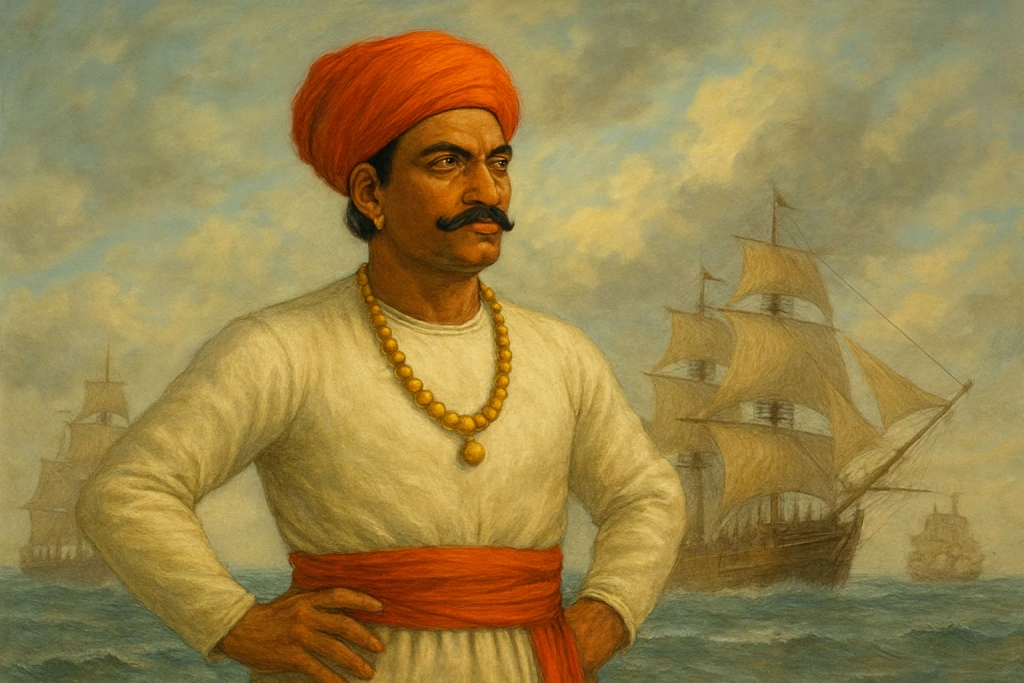
When we think of India’s struggle against colonial powers, the stories often center on land wars, resistance leaders, and freedom fighters of the 19th and 20th centuries. Yet, a chapter that deserves equal attention is the maritime defense of India’s western coast during the early 18th century. At the center of that story stands Kanhoji Angre, the legendary Maratha Admiral, who built one of the most formidable indigenous navies of his time.
While the British, Portuguese, and Dutch tried to assert control over the Arabian Sea, Kanhoji Angre’s Maratha Navy disrupted their dominance, forcing European powers to negotiate with an Indian commander on equal terms. His legacy, though often overshadowed in mainstream history, remains a vital part of India’s naval heritage.
Early Life of Kanhoji Angre
Kanhoji Angre was born around 1669 in a humble family on the Konkan coast of Maharashtra. His father, Tukoji, was a commander serving under the Maratha chief Shivaji. Growing up in a coastal environment, Kanhoji developed a natural familiarity with the sea, boats, and fishing villages that dotted the Arabian shoreline.
By the late 17th century, as the Maratha Empire consolidated its power under Sambhaji and later Rajaram, the need for a strong maritime defense became evident. European trading companies had begun to convert commercial interests into territorial ambitions, and coastal raids by the Portuguese and Siddis of Janjira threatened Maratha control of trade.
Kanhoji Angre emerged in this turbulent backdrop, soon to become the Admiral of the Maratha Navy.
Rise of the Maratha Navy
Shivaji had already laid the foundation for a naval force in the 1660s, recognizing the importance of securing trade routes and defending the Konkan coast. However, after his death, the Maratha fleet weakened.
Kanhoji Angre revived and expanded this naval power. Appointed as the Sarkhel (Admiral) by Maratha rulers, he took command of coastal forts such as Kolaba, Suvarnadurg, and Vijaydurg. These forts became strategic naval bases, allowing him to control shipping lanes and protect Maratha territories from foreign intrusion.
What set Kanhoji apart was his understanding of sea power in a time when few Indian rulers prioritized naval strength. He built fleets of grabs and gallivats—small, swift, locally made ships—that could outmaneuver the larger European vessels.
Read more, Swami Vivekananda Chicago Speech 1893: Honoring Sanatan Dharma and India’s Voice to the World
Naval Tactics and Warfare
Kanhoji Angre’s genius lay not only in fleet building but in tactics. He pioneered a style of guerrilla naval warfare, much like Shivaji’s guerrilla land strategies. His ships would attack in swarms, overwhelming larger European frigates and seizing cargo.
Key Features of His Strategy:
- Speed over Size: Instead of matching European ships in size, Angre relied on smaller, faster vessels.
- Coastal Knowledge: His sailors knew every cove, creek, and river inlet, giving them a natural advantage.
- Fortresses as Anchors: Coastal forts served as supply bases, repair docks, and lookout points.
- Psychological Warfare: European powers began to fear Maratha naval raids, adjusting routes to avoid Angre’s patrol zones.
These tactics earned him the title of “Shivaji of the Sea”.
Conflict with European Powers
Against the Portuguese
The Portuguese, who had dominated western Indian waters since the 16th century, were the first to clash with Kanhoji Angre. Their attempts to control trade were regularly thwarted by his raids. Despite multiple expeditions, the Portuguese never managed to decisively defeat him.
Against the Dutch
The Dutch East India Company, eager to protect its spice trade, fought several battles with Angre’s fleet. However, Angre’s nimble strategies meant that even the well-equipped Dutch could not secure a lasting victory.
Against the British
The most famous confrontations were with the British East India Company. In 1712, Kanhoji seized the Company’s ship Anne, loaded with treasure. This emboldened him, and soon British merchants began complaining of piracy.
The British launched multiple campaigns, often in alliance with the Portuguese. In 1721, they attempted a large-scale assault on Angre’s bases but suffered defeat. Despite superior firepower, they could not subdue him.
Kanhoji Angre and the “Pirate” Label
European records often describe Kanhoji Angre as a pirate. But from an Indian perspective, he was a naval commander defending his nation’s coastline.
The labeling reflects colonial bias. While European companies seized lands, imposed trade monopolies, and attacked local shipping, they branded Angre’s defense of the Konkan coast as piracy. In reality, he was exercising sovereignty over Indian waters, collecting customs duties, and ensuring Maratha control of trade.
Modern historians increasingly recognize Angre as a legitimate admiral, not a pirate.
Read more, Indian Navy: History & Heritage
Administration and Naval Organization
Kanhoji Angre’s success also came from disciplined administration. He divided responsibilities among trusted lieutenants, fortified coastal outposts, and maintained supply lines. His sailors came from local fishing communities, creating a strong sense of loyalty.
Revenue was generated through duties on passing ships and seized cargo. Unlike pirates, Angre ran an organized system, sharing spoils with the Maratha state. His administration kept the navy self-sustaining and effective.
Relations with the Maratha Court
Kanhoji Angre operated with relative autonomy but remained loyal to the Maratha rulers. During the reign of Shahu Maharaj, he was officially recognized as the Admiral of the Fleet.
Tensions did arise when court factions in Satara sought to limit his power, but Angre skillfully navigated politics. His naval strength made him indispensable, ensuring that even the Peshwas could not undermine his authority completely.
Personal Life and Legacy
Kanhoji Angre was known for his discipline, austerity, and strategic foresight. He spent most of his life at sea or in coastal forts, rarely leaving the Konkan region. He passed away in 1729, after nearly three decades of unmatched naval dominance.
After his death, his sons attempted to carry forward his legacy, but internal divisions within the Maratha navy weakened it. Nevertheless, the memory of his victories survived in coastal folklore and local history.
Historical Significance of Kanhoji Angre
Kanhoji Angre’s legacy is important for several reasons:
- First Indian Naval Commander – He is often called India’s first great admiral.
- Defender of Sovereignty – He prevented European monopoly of Indian waters.
- Naval Innovator – His tactics predated modern naval doctrines of speed and maneuverability.
- Symbol of Resistance – Angre represents indigenous defiance against colonial expansion.
Modern Recognition
For decades, Kanhoji Angre was forgotten in mainstream Indian history. But recent years have seen a revival of interest.
- The Indian Navy has named a base in Mumbai as INS Angre in his honor.
- Statues and memorials have been erected along the Konkan coast.
- Scholarly works and documentaries highlight his role as a pioneer of Indian naval power.
Yet, more needs to be done to integrate his story into the broader narrative of India’s resistance to colonialism.
Editorial Reflection: Why Kanhoji Angre Matters Today
In today’s geopolitical climate, with India once again focusing on maritime security through initiatives like Sagarmala and the Indian Ocean Naval strategy, Kanhoji Angre’s legacy feels more relevant than ever.
He reminds us that control of the seas is as important as control of land. In the 18th century, his fleet ensured that European powers never felt fully secure in Indian waters. In the 21st century, his story inspires a renewed focus on indigenous naval strength and strategic foresight.
Ignoring Kanhoji Angre is not just a loss to historical memory but a missed opportunity to celebrate an Indian hero who stood firm against global colonial powers.
Conclusion
Kanhoji Angre was more than a Maratha admiral. He was a visionary leader who understood the importance of sea power at a time when most Indian rulers neglected it. His story challenges colonial narratives, reclaims India’s maritime heritage, and establishes him as a pioneer of naval defense.
Though his name may not feature prominently in school textbooks, his legacy lives on in the waves of the Arabian Sea and in the Indian Navy that continues to guard the nation’s maritime frontiers.