
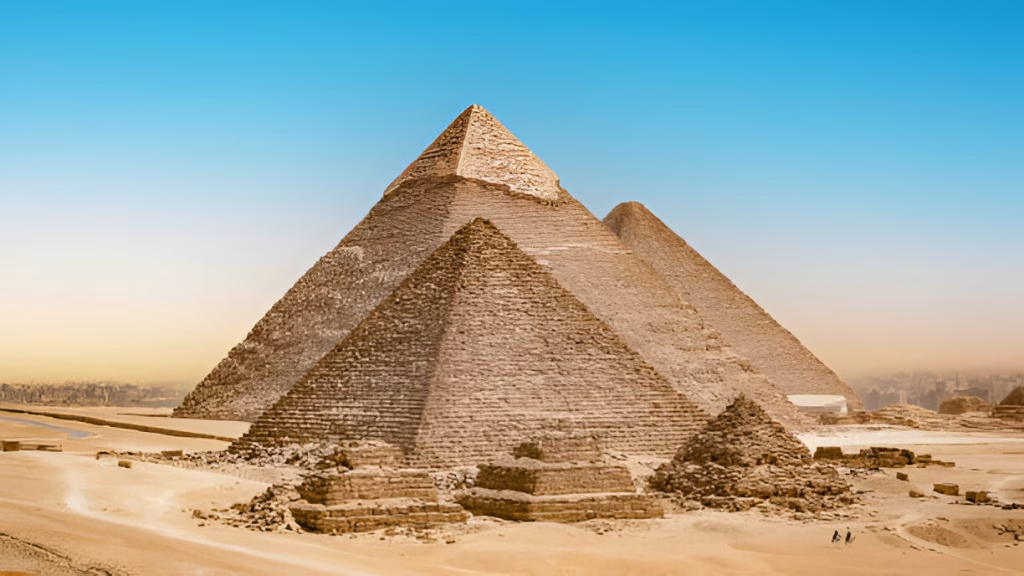
Great Pyramid in Egypt, since there are no surviving ancient manuscripts that explain how the massive stone blocks were lifted and assembled so quickly, archaeologists have long been puzzled by the Great Pyramid’s construction.
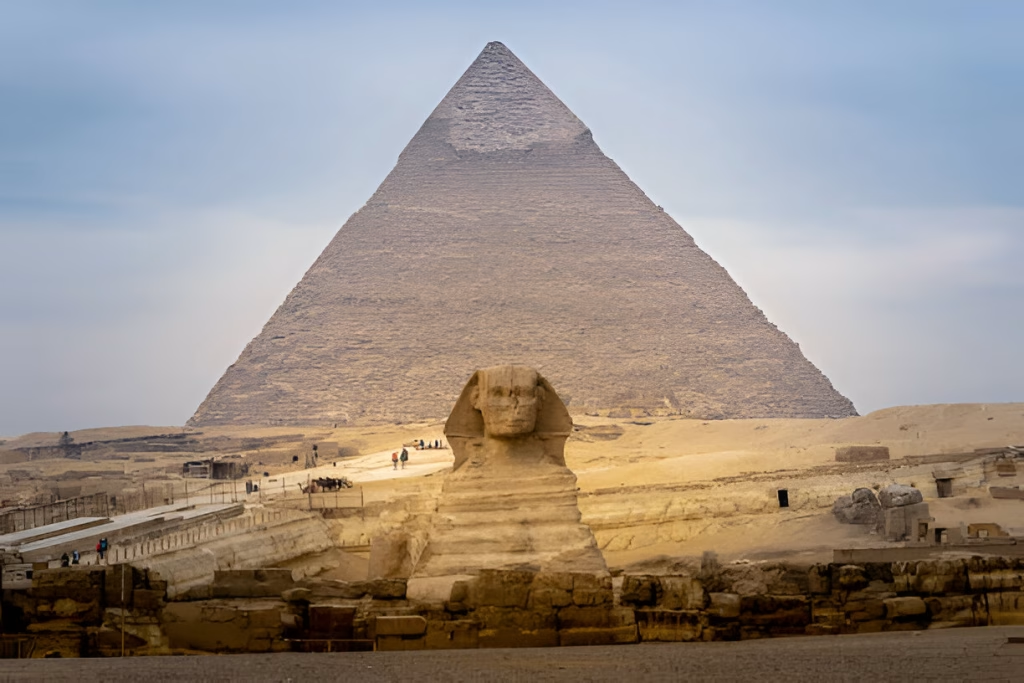
The hundreds of feet that stones weighing up to 60 tons were raised in just 20 years defies conventional theories, which rely on ramps and a gradual, layer-by-layer construction.
The pyramid was built using an internal system of pulley-like systems and counterweights, according to a recent analysis.
In a study published in Nature, Dr. Simon Andreas Scheuring of Weill Cornell Medicine in New York calculated that builders could lift and arrange massive blocks at a startling rate sometimes as fast as one block per minute.
Also read, Expert: 6 Winter Season Hair Care Mistakes You’re Making
He insisted that the force needed to move stones to the higher levels of the Khufu Pyramid could only have been produced by sliding counterweights rather than brute-force hauling.
According to the study, which also found architectural features inside the pyramid that support this theory, the Grand Gallery and Ascending Passage are sloped ramps where counterweights may have been dropped to provide a lifting force.
The Antechamber was once thought to be a security feature, but it has since been reinterpreted as a pulley-like system that could help lift even the largest blocks.
If the analysis was correct, it showed that the Great Pyramid was constructed from the inside out, starting with an interior core and using covert pulley systems to raise stones as it grew.
Great Pyramid in Egypt
The Great Pyramid of Khufu is the largest and oldest of the Giza pyramids, having been constructed as Pharaoh Khufu’s tomb in 2560 BC, or 4,585 years ago.
The pharaoh’s mummy and treasures have never been found, despite the pyramid being the world’s tallest structure for millennia and the only Ancient Wonder that is largely intact.
It is well known for both its precise construction using millions of stone blocks and its elaborate internal passageways leading to the King’s Chamber.
According to the most recent study, massive counterweights slid downward along sloped interior pathways, raising blocks upward in other parts of the core.
According to the most recent study, massive counterweights slid downward along sloped interior pathways, raising blocks upward in other parts of the core.
Instead of using the Grand Gallery and the Ascending Passage as ceremonial corridors, Scheuring transformed them into internal construction ramps.
He pointed to polished surfaces, wear marks, and scratches on the walls of the Grand Gallery as evidence that large sledges had initially passed frequently along its length, indicating mechanical stress appropriate for sliding loads rather than foot traffic or ceremonial use.
The study also provided a new explanation for the Antechamber, a small granite room directly in front of the King’s Chamber.
Once thought to be a security feature intended to discourage tomb robbers, the Antechamber is now reconsidered as a pulley-like hoisting station.
It appears to have been a working machine rather than a finished ceremonial space due to its remarkably rough construction, stone supports that would have supported wooden beams, and grooves carved into its granite walls.
By running ropes over wooden planks positioned inside the Antechamber, workers would have been able to lift stones up to 60 tons during Scheuring’s restoration.
The system could be adjusted to increase lifting power when necessary, much like changing gears.
The chamber was once connected to a vertical shaft that was sealed after construction was finished, as evidenced by large rope grooves and an uneven inlaid floor.
Scheuring argued that the interior architecture of the pyramid, which extends beyond individual rooms, is characterized by engineering limitations rather than symbolic design.
Major chambers and corridors are arranged near a common vertical axis, despite being oddly skewed rather than correctly centered.
For example, the Queen’s Chamber is oriented north-south but not east-west, while the King’s Chamber is located noticeably south of the pyramid’s central axis.
Such anomalies are difficult to explain if the pyramid was built smoothly from the ground up using external ramps.
Builders could have symmetrically positioned rooms anywhere they wanted in a traditional form.
Instead, the offsets show that builders were getting around the mechanical constraints of internal lifting systems.
The theory also offered explanations for puzzling external features, like the modest concavity of the pyramid’s faces and the complex pattern of the stone layers’ gradual height changes.
According to Scheuring, these features could demonstrate how internal ramps and lifting points evolved as the pyramid ascended and the stones became lighter at higher levels.
Significantly, the model produces testable predictions, indicating that the core of the pyramid does not contain any sizable, undiscovered chambers. Recent muon-scanning surveys corroborate this theory.
However, in the outer parts of the building, especially higher up, there might still be smaller hallways or the remains of internal ramps.
Scheuring’s theory could fundamentally alter how archaeologists comprehend the Great Pyramid and the construction of pyramids throughout ancient Egypt if it is validated by new findings.


One Comment