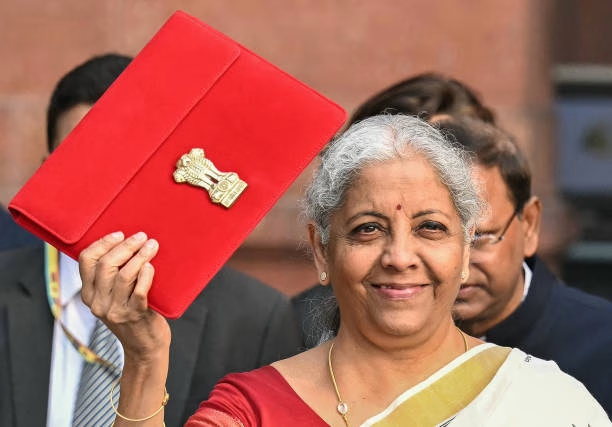
Income tax projections for the 2026 budget: The finance minister will present the Union Budget 2026 against a backdrop of uncertain geopolitical dynamics, volatile capital markets, a range of regulatory reforms (including labour codes and a new income tax act), volatile oil prices, the INR-USD exchange rate, and other uncertainties. But one thing is for sure: on a warm Sunday afternoon on February 1, 2026, the promise of higher net discretionary income will have individual taxpayers giddy with anticipation.
Income taxes in 2026
However, as India prepares to implement the new Income-tax Act on April 1, 2026, expectations of substantial tax changes may need to be modified. The budget may focus on minor, practical changes and administrative improvements, like faster refunds, simpler compliance, etc., to improve the taxpayer experience and ensure a smooth transition to the new law.
In light of the aforementioned, individual taxpayers can still anticipate that the following problems will be resolved:
A Higher Standard Deduction
One of the most frequently stated goals is to increase the standard deduction, which is currently at Rs 50,000 under the previous tax system and Rs 75,000 under the current one. Because living expenses are rising due to inflation, salaried taxpayers hope that the deduction limit will be increased to at least Rs 1 lakh. Taxpayers would benefit from a larger deduction at a time when growing living expenses are putting more strain on household finances.
Also read, Why are Amazon, Intel, Microsoft, and 17 other companies cutting 165,000 jobs?
Conditions for Evaluating Electric Vehicles
Since electric vehicles (EVs) are increasingly seen as the mobility of the future, many employers are now encouraging employees to select an EV under their company car lease policy in keeping with their larger ESG commitments. The unique features of electric vehicles (EVs), which do not have an engine in the conventional sense, are ignored by the current perquisite value regulations, which still only consider the car’s cubic capacity. Therefore, it may be possible for the government to establish a unique EV valuation system in order to ensure an appropriate tax treatment and to further encourage the adoption of EVs.
It is anticipated that the government may permit such an interest deduction in the next budget, at least for self-occupied property under the new tax regime, given the ongoing rise in housing prices and the government’s overarching goal of encouraging home ownership at reasonable rates. Families with middle-class incomes would benefit from this, and taxpayers’ trust in the new tax system would grow.
Interest Reduction on Home Loans Under the New Tax System
Home loan borrowers have historically used interest-related tax deductions to reduce their repayment obligations. Under the new tax system, people cannot deduct housing loan interest from their salary income, even if they own a self-occupied property.
Given the continuous increase in home prices and the government’s overarching objective of promoting home ownership at reasonable rates, it is expected that the government may allow such an interest deduction in the next budget, at least for self-occupied property under the new tax regime. This would help families with moderate incomes and increase public confidence in the new tax system.
Timetables for Modified or Delayed Returns
Currently, the deadline for filing an amended or belated return for a fiscal year is December 31st of the subsequent year. However, this schedule often causes problems, particularly for individual taxpayers with cross-border income or investments, since tax filings in their home or host countries may not be finished by then. This disparity could result in unintentional underreporting or over-reporting of income in India. For instance, a US citizen who becomes an ordinary resident of India may be required to record global income for parts of two calendar years in a single Indian tax return, even though foreign tax filings are completed later. Given these practical difficulties, extending the deadline for filing amended or delayed returns would provide much-needed relief and help ensure accurate reporting.
As the government prepares for the historic shift to the new Income-tax Act in April 2026, the Union Budget presents an opportunity to address a number of long-standing demands of individual taxpayers. Although significant changes are unlikely in a year of transition, targeted improvements, like more deductions or more flexible deadlines, could significantly improve the taxpayer experience. Ultimately, it is hoped that the budget will appropriately strike a balance between budgetary discipline and the demands of India’s growing salaried class.