Introduction: Skull Unearthed in China
Archaeology has always reshaped how we see ourselves. From the first Neanderthal bones in Europe to the Denisovan DNA hidden in our genes, every fossil discovery adds a twist to the complex tale of human origins. Now, a skull unearthed in China has ignited fresh debate among scientists, raising questions that challenge one of the most widely accepted theories of human evolution.
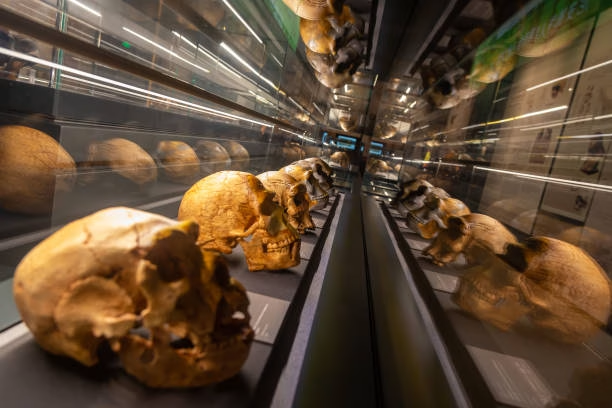
The find is extraordinary not only for its preservation and age but also for the features it carries—traits that blur the line between archaic and modern humans. Could it represent a new human species, or does it prove that Asia played a far bigger role in our evolutionary journey than we ever imagined?
What Exactly Was Found?
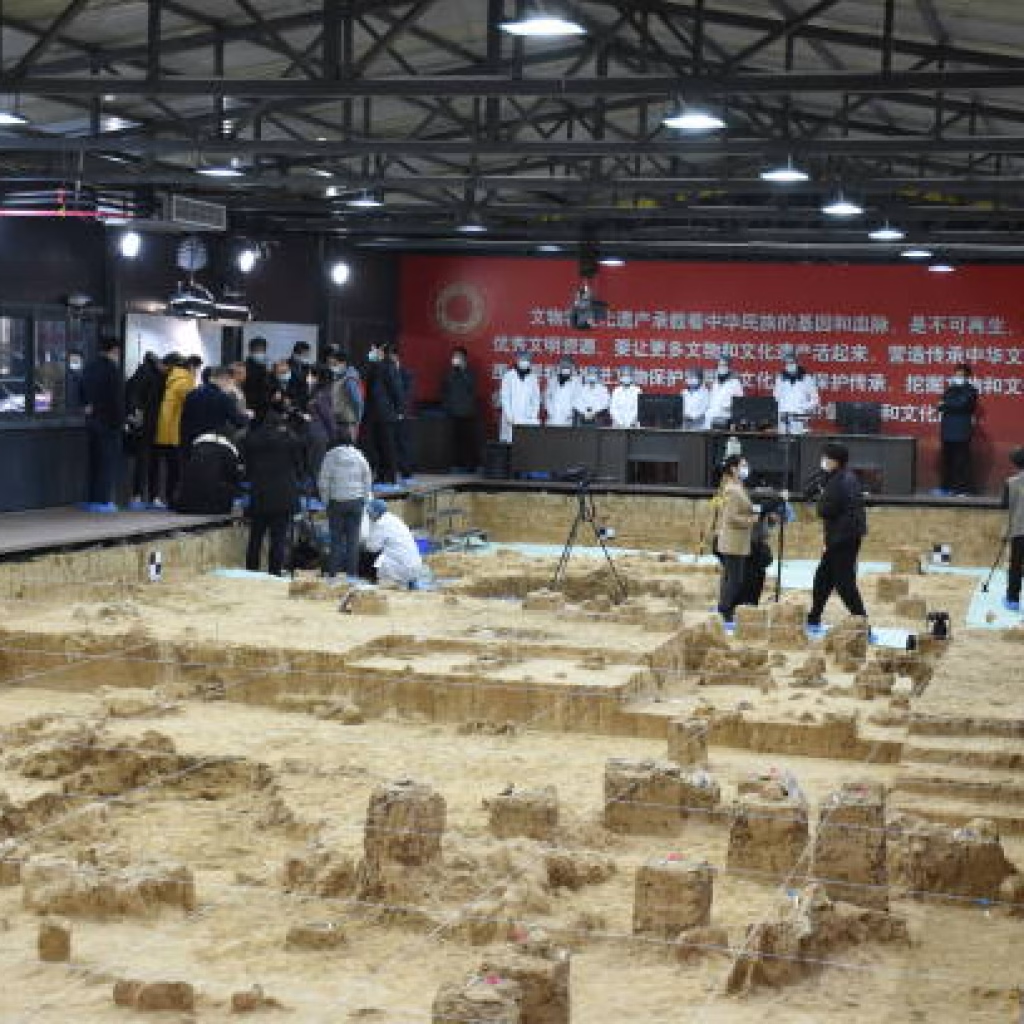
The fossil, uncovered in eastern China during a systematic excavation of prehistoric settlements, is remarkably well-preserved. Unlike fragmented skulls often recovered at dig sites, this one provides a nearly complete view of the braincase, brow ridges, and facial structure.
Initial observations reveal a fascinating mix:
- Pronounced brow ridges, resembling archaic humans such as Homo erectus.
- A rounded cranial vault, closer to modern Homo sapiens.
- Large brain capacity, suggesting advanced cognitive abilities.
- Robust jawline and thick skull bones, typically seen in earlier hominins.
These features make classification difficult. Is it an archaic human holding onto ancient traits, or a hybrid population shaped by interbreeding?
Also read, Kantara A Legend Chapter 1: Epic Prequel Unveils Mystical Origins
Dating the Fossil: How Old is It?
Dating techniques, including uranium-series analysis and stratigraphy, suggest the skull is between 146,000 and 300,000 years old. That places it in the same time frame as early modern humans in Africa, Neanderthals in Europe, and Denisovans in Siberia.
If accurate, the skull represents a parallel human lineage in East Asia—one that may have survived long enough to interact with modern humans migrating into the region.
Out of Africa vs. Multi-Regional Evolution: The Debate Rekindled
For decades, the “Out of Africa” model has dominated evolutionary theory. It argues that all modern humans descended from a common African ancestor who lived around 200,000 years ago. These humans migrated outward, replacing archaic populations across the globe.
The Chinese skull discovery fuels discussion of an alternative: the multi-regional hypothesis. This theory suggests that humans evolved in different parts of the world simultaneously, with gene flow between regions maintaining one species.
The fossil’s unique traits could indicate:
- A regional branch of humans in Asia evolving alongside African populations.
- Interbreeding events that brought together traits from multiple hominin groups.
- A “ghost lineage”—a population that contributed genetically but later vanished.
How It Compares with Other Discoveries
This isn’t the first time Asian fossils have challenged the African-centered narrative.
- Denisovans (Siberia): A finger bone and teeth discovered in Denisova Cave revealed a previously unknown human group. Their DNA still exists in modern populations across Asia and Oceania. (Science)
- Homo floresiensis (Indonesia): Nicknamed “Hobbits,” these tiny humans lived as recently as 50,000 years ago.
- Dragon Man (Harbin, China): A massive skull discovered in 2018 was suggested as another distinct human lineage.
- Dali Man (China, 1978): An earlier skull showing a mix of archaic and modern traits.
Together, these finds suggest that Asia hosted a remarkable diversity of human species, far beyond what textbooks once taught.
Reactions from the Scientific Community
The Chinese skull has drawn mixed reactions:
- Excitement: Many anthropologists see it as proof that human evolution was not linear but a network of overlapping populations.
- Skepticism: Others caution that fossil evidence alone is not enough. Without DNA extraction, it’s difficult to place the skull on the human family tree.
- Optimism: Researchers are hopeful that continued excavations will provide more specimens, helping confirm whether this was indeed a distinct species or an early population of modern humans.
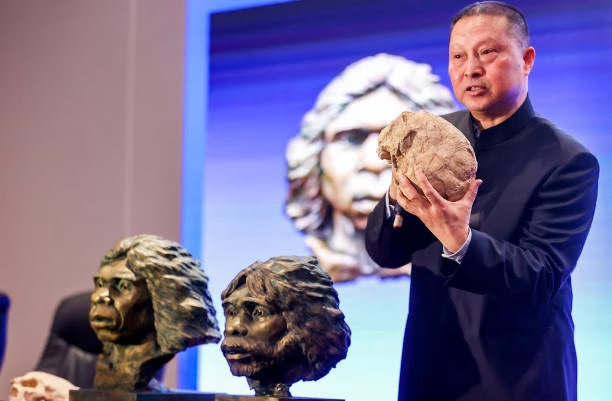
Dr. Wu Xinzhi, one of the senior Chinese researchers, explained:
“The features we see cannot be explained by simple migration or replacement. This skull reveals the mosaic nature of human evolution.”
What This Means for Modern Humans
If the fossil represents a new species or hybrid population, it forces us to rethink questions like:
- Did modern humans interbreed with multiple populations across Asia?
- Could modern East Asian genetics carry traces of this ancient lineage?
- Was human evolution less about replacement and more about absorption and survival?
This discovery may also highlight that innovation and survival didn’t belong exclusively to Africa or Europe. Asia was an equally vibrant stage in humanity’s evolutionary drama.
A Broader Look: Evolution Was Never Simple
Textbooks once presented evolution as a straight line: Homo erectus → Neanderthals → Homo sapiens. Fossil evidence now paints a very different picture: a bushy evolutionary tree with multiple branches, some leading to us, others ending in extinction.
Humans lived, migrated, and interbred in waves:
- Neanderthals in Europe contributed DNA to modern Eurasians.
- Denisovans shaped immune systems of present-day Tibetans.
- Possible “ghost populations” left genetic fingerprints without leaving fossils.
The Chinese skull fits into this emerging picture—proof that our origins were complex, tangled, and collaborative.
Conclusion: A Puzzle with Missing Pieces
The skull unearthed in China may never give us a complete answer. But it does something equally important—it keeps the human story alive, open, and evolving.
As new tools like ancient DNA sequencing and AI-driven fossil analysis advance, we may soon find ourselves rewriting the narrative of our species.
For now, the message is clear: our past was not simple, our journey was not solitary, and our origins were not confined to one place.
The skull is not just a fossil—it is a reminder that the story of humanity is still being written, bone by bone, discovery by discovery.