While Google’s Gemini has stayed steady, traffic to OpenAI’s ChatGPT has sharply declined in recent weeks, according to Similarweb, a web traffic measurement company.
ChatGPT‘s average daily visitors dropped by 22% over the preceding six weeks, and its seven-day average dropped from about 203 million to about 158 million. The reduction has helped close the gap between the two consumer AI platforms, which together serve hundreds of millions of people worldwide, even though Gemini’s usage has essentially remained unchanged.
According to Similarweb’s data, ChatGPT saw about 200 million daily visitors for most of December 2025 and January 3, 2026, but in early January, traffic fell to about 158 million. However, Gemini’s traffic remained consistent at 55–60 million daily visits over the same period.
Industry insiders claim that Google’s distribution power is a major factor in Gemini’s steady usage.
“Google does not necessarily need to out-innovate the competition, but it needs to out-distribute it,” Jaspreet Bindra, cofounder of AI & Beyond. It is currently doing that by using distribution. Because Gemini is integrated into search (through AI overviews and the AI mode), Workspace, Android, and the OS-level experience, users don’t need to go to another website or application.
According to Bindra, distribution is turning into a key differentiator in the consumer AI market. He claims that the closing Gemini-ChatGPT difference shows that, at least in consumer usage metrics, superior reach across search, OS systems, email, and productivity applications may make up for even a technical lag.
Gemini rises while ChatGPT stays the same
Research suggests that ChatGPT’s growth trajectory has recently slowed, despite the fact that it is still the most popular AI interface globally. According to Similarweb, Gemini’s share of ChatGPT’s traffic increased from 31–33% in early December to about 39–40% by the end of the month.
The study also shows that, despite their smaller numbers, Gemini users are more involved. ChatGPT’s average visit duration was 6 minutes 32 seconds, whereas Gemini’s was 7 minutes 20 seconds. Gemini users viewed 4.3 pages per visit as opposed to 3.8 pages on ChatGPT, indicating more in-depth conversations per session.
Regarding ChatGPT’s recent decline, analysts have two opinions. The first is a seasonal slowdown that usually happens during the holiday in December, when there is typically less internet traffic. The second is Gemini’s growing appeal following the release of its most recent model upgrade in November 2025 and the addition of new features in mid-December, both of which have garnered positive customer feedback.
Also read, The PSLV-C62 EOS-N1 Anvesha will be launched by ISRO on January 12, 2026
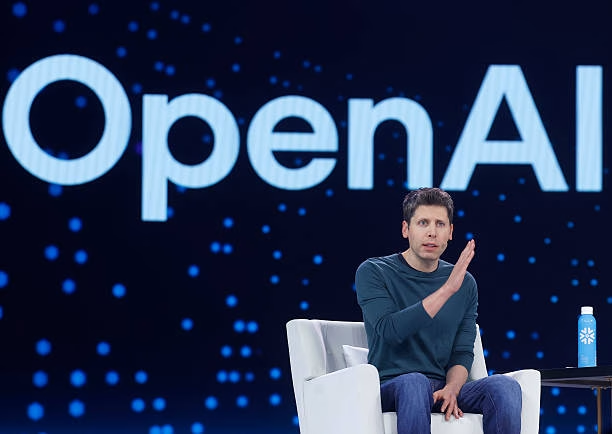
Viren Inaniyan, cofounder of Asva AI, said, “ChatGPT’s drop was expected as they had their last release on December 11.” Gemini’s intense competition prompted Open AI CEO Sam Altman to issue a “code red” earlier in December.
At launch, Google claimed that the new Gemini model might help users understand text, images, audio, and video more quickly. The new model can interpret audio, analyze visual content, and assist with complex questions.
Using Canvas to create apps, Nano Banana to create graphics, deep research, and Guided Learning to explain topics are just a few of the tasks that the new Gemini 3 Flash model can perform. Users can also test out agent-like shopping experiences. Google claims that Gemini 3 Flash can perform up to three times better than Gemini 2.5 Pro.
Some AI models remain dubious
Other AI models are also becoming more and more well-liked. According to Similarweb, Grok received 247 million visits (3.51%), DeepSeek received 282 million visits (4%), and Perplexity.ai received 154.9 million visits (2.19%) in December.
Industry observers say the need for large language models is growing rather than declining. They noted that general-purpose AI tools like ChatGPT and Gemini are still widely used despite heightened competition.
Adoption is transitioning from a “toy” phase to an infrastructure phase, according to Bindra. He went on, “Increased integration into operating systems and productivity suites shows that LLMs are becoming embedded into everyday tools, which favors incumbents with large platforms like Google, Microsoft, and Meta, as much as or more than standalone destinations.”
If something makes them feel even a little better, they are eager to try it. According to Srikanth Velamakanni, CEO and cofounder of Fractal Analytics, usage trends clearly demonstrate that behavior.