The Indian Space Research Organization (ISRO) will resume orbital launches with the PSLV-C62 mission, which is scheduled to launch from the First Launch Pad (FLP) at the Satish Dhawan Space Center in Sriharikota on January 12, 2026, at 10:17 AM IST.
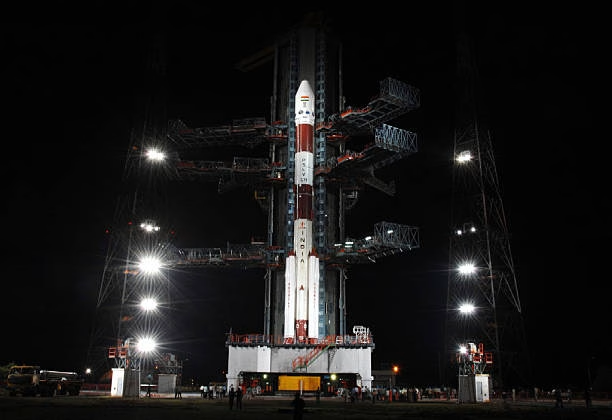
The launch will mark the 64th flight of the Polar Satellite Launch Vehicle (PSLV) and the fifth use of the PSLV-DL type, which has two strap-on boosters.
EOS-N1 Anvesha
The primary payload of the mission is EOS-N1 (Anvesha), an Earth observation satellite designed to enhance India’s remote sensing capabilities in agriculture, urban mapping, and environmental monitoring.
With eighteen co-passenger payloads from India and other nations, this is a significant multi-satellite deployment.
EOS-N1 Anvesha and other 8 satellite
One of the co-passengers is AayulSAT, developed by Bengaluru-based OrbitAID Aerospace and praised as India’s first on-orbit refueling mission—a critical step toward reusable and sustainable satellite operations.
Hyderabad’s TakeMe2Space and EON Space will launch MOI-1, a tiny 14-kilogram satellite with onboard AI data processing and Earth imaging capabilities, to demonstrate next-generation edge computing in orbit.
The Indo-Mauritius Joint Satellite (IMJS) would strengthen the two nations’ space cooperation while bringing a global perspective.
Orbital Paradigm’s Kestrel Initial Demonstrator (KID) will test a 25-kilogram reentry capsule from Spain, potentially paving the way for low-cost recovery technologies for microgravity research and sample return missions. The PSLV’s first flight back into service following the PSLV-C61 mission’s failure in late 2025 makes this trip noteworthy as well.
The C62 mission, which is ISRO’s 101st orbital attempt overall and the first orbital launch of 2026, represents a technical and symbolic revitalization for the renowned workhorse launcher.
If PSLV-C62 is successful, it will validate ISRO’s reliability in the deployment of small and medium-sized satellites and bolster India’s growing network of private and international space partnerships.