Introduction: RSS 100 years journey
The Rashtriya Swayamsevak Sangh (RSS) marks its centenary in 2025, completing 100 years since its founding in Nagpur by Dr. Keshav Baliram Hedgewar. What started in 1925 as a small cultural organization with a few dozen young men gathering in a field has grown into one of the largest voluntary organizations in the world, with an estimated 6–8 million members and a vast influence that reaches far beyond its headquarters.
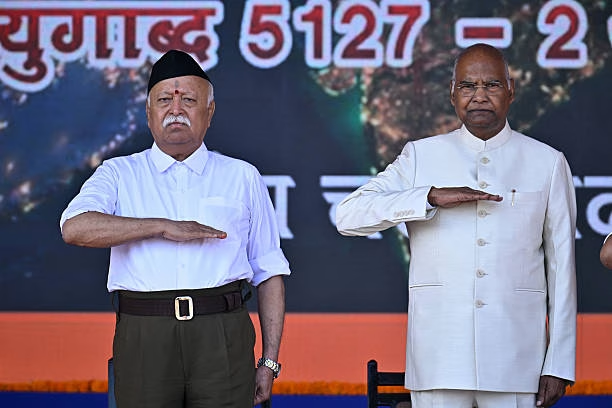
For supporters, the RSS represents discipline, cultural pride, and a framework for national unity. For critics, it has often been portrayed as controversial, accused of being rigid or exclusionary. Yet, irrespective of opinion, few deny its enormous role in shaping modern India.
This centenary is not just a milestone for the RSS; it is a lens to understand how a voluntary cultural movement became a force that influences politics, education, society, and global perceptions of India.
Join RSS here.
The Birth of the RSS (1925)
The Founding Context
The RSS was born in 1925, at a time when India was under British colonial rule and nationalist movements were gaining strength. Hedgewar, a physician from Nagpur, was influenced by both the freedom movement and the cultural renaissance emerging in the late 19th and early 20th centuries.
He felt that while political struggle was important, cultural unity and social discipline were equally crucial. The Hindu community, in his view, was divided by caste, region, and language. To counter this, Hedgewar envisioned a disciplined volunteer corps that could embody national pride.
Also read, Kantara : A Legend – Chapter 1 to Hit Theatres on October 2, 2025: Everything You Need to Know
The First Shakha
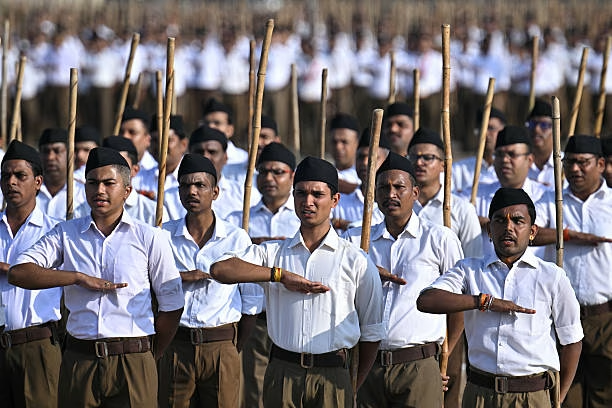
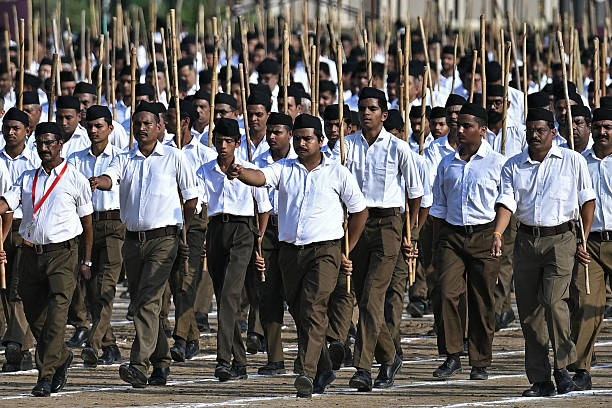
The first shakha (branch) took place in 1925 with just five boys in Nagpur. The daily shakha would become the core of the RSS’s organizational model: physical training, patriotic songs, discipline, and group activities. Over time, this simple format scaled across India.
Ideological Roots
The RSS was built around the concept of “Hindutva” as articulated by Veer Savarkar — not strictly religious, but cultural and civilizational in nature. For the Sangh, Hindu identity equated to Indian identity, positioning Bharat Mata (Mother India) as sacred.
The organization did not originally participate in political freedom struggles like the Indian National Congress. Instead, it focused on nation-building through character-building. This strategic focus distinguished it from other movements of the time.
The Early Growth and Struggles
- 1930s–40s Expansion: By the 1930s, the RSS had spread beyond Nagpur, opening shakhas in multiple states.
- Post-Gandhi Assassination Ban (1948): After Mahatma Gandhi was assassinated by Nathuram Godse, who had earlier been associated with the Sangh, the RSS was banned. Investigations later cleared the organization of direct involvement, and the ban was lifted in 1949.
- Leadership of M. S. Golwalkar: Hedgewar’s successor, Madhav Sadashiv Golwalkar (Guruji), expanded the RSS network and gave it a more structured ideology.
From Cultural Movement to Political Power
Though the RSS initially kept away from politics, its influence seeped into political movements:
- Jana Sangh (1951): The RSS inspired Syama Prasad Mukherjee to found the Bharatiya Jana Sangh, the political precursor to today’s BJP.
- Emergency Resistance (1975–77): During Indira Gandhi’s Emergency, RSS cadres actively resisted authoritarian rule, earning legitimacy as defenders of democracy.
- Rise of BJP (1980s–90s): The Bharatiya Janata Party, closely aligned with RSS ideology, grew significantly during the Ram Janmabhoomi movement, culminating in the demolition of the Babri Masjid in 1992.
- BJP in Power (2014 onwards): With Narendra Modi, a former RSS pracharak, becoming Prime Minister in 2014, the RSS’s political vision achieved unprecedented mainstream acceptance.
The Sangh Parivar Ecosystem
The RSS is not just one organization; it is the nucleus of a vast network known as the Sangh Parivar.
- VHP (Vishwa Hindu Parishad): Focused on cultural and religious mobilization.
- ABVP (Akhil Bharatiya Vidyarthi Parishad): Student wing active in universities.
- BMS (Bharatiya Mazdoor Sangh): One of India’s largest trade unions.
- Seva Bharati: Social service arm engaged in disaster relief, healthcare, and rural development.
- SJM (Swadeshi Jagran Manch): Advocates for economic nationalism.
Through these organizations, the RSS has created a multi-dimensional influence — from politics to labor, from education to cultural reform.
100 Years of Service and Expansion
Today, the RSS has:
- 60,000+ shakhas across India.
- Global presence in more than 40 countries through Hindu Swayamsevak Sangh (HSS).
- Thousands of seva projects in rural development, literacy, women empowerment, and healthcare.
Its 100th-year celebrations in 2025 include:
- Special shakhas in major cities.
- Publications chronicling RSS’s history.
- International conferences on culture and nationhood.
- A large-scale outreach program to showcase seva work.
RSS and Its Critics
While supporters hail the RSS as a nation-building force, critics argue it has promoted a narrow identity-based ideology. Academic and political debates often center around its stance on minorities, secularism, and nationalism.
However, in practice, the Sangh has also run projects in Muslim-majority areas, tribal villages, and marginalized communities, presenting itself as inclusive in seva, if not in ideology.
The Modi Era: RSS in Governance
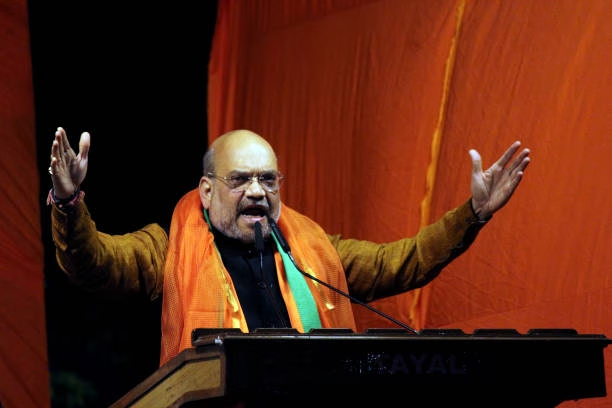
Prime Minister Narendra Modi, along with key leaders like Amit Shah, Rajnath Singh, and others, all trace their political roots back to the RSS. Under Modi, the RSS vision has translated into:
- Cultural Assertion: Revitalization of Indian traditions and heritage.
- Social Welfare: Schemes on sanitation, housing, and financial inclusion aligning with seva spirit.
- National Security: Stronger positions on defense and border issues.
While Modi maintains autonomy from the RSS in some governance decisions, the Sangh’s ideological imprint is visible in policymaking.
Global Impact of the RSS
The RSS is no longer limited to India. The Hindu Swayamsevak Sangh (HSS) runs activities in the U.S., U.K., Africa, and Southeast Asia. Through diaspora engagement, cultural festivals, and Hindu temples, the RSS has become an ambassador of Indian culture worldwide.
100-Year Milestone: Symbolism and Future
As the RSS celebrates its centenary, it stands at a crossroads:
- Symbol of Continuity: A century of discipline, seva, and nation-first ideology.
- Political Influence: The strongest ever with BJP dominance.
- Challenges: Adapting to digital disruption, generational shifts, and global scrutiny.
The RSS leadership emphasizes that the next century will focus on youth engagement, technology, and global outreach, while keeping its core intact.
Conclusion: The Legacy of the RSS
From its humble beginnings in Nagpur to becoming a cultural and political powerhouse, the RSS has completed a journey that few organizations in the world can match. Its centenary is not just a celebration of longevity, but of influence — an influence that has redefined Indian politics, culture, and identity.
Love it or hate it, the RSS is now an inseparable part of India’s story. As it steps into the next century, the question is not whether it will shape India’s future, but how deeply it will continue to do so.