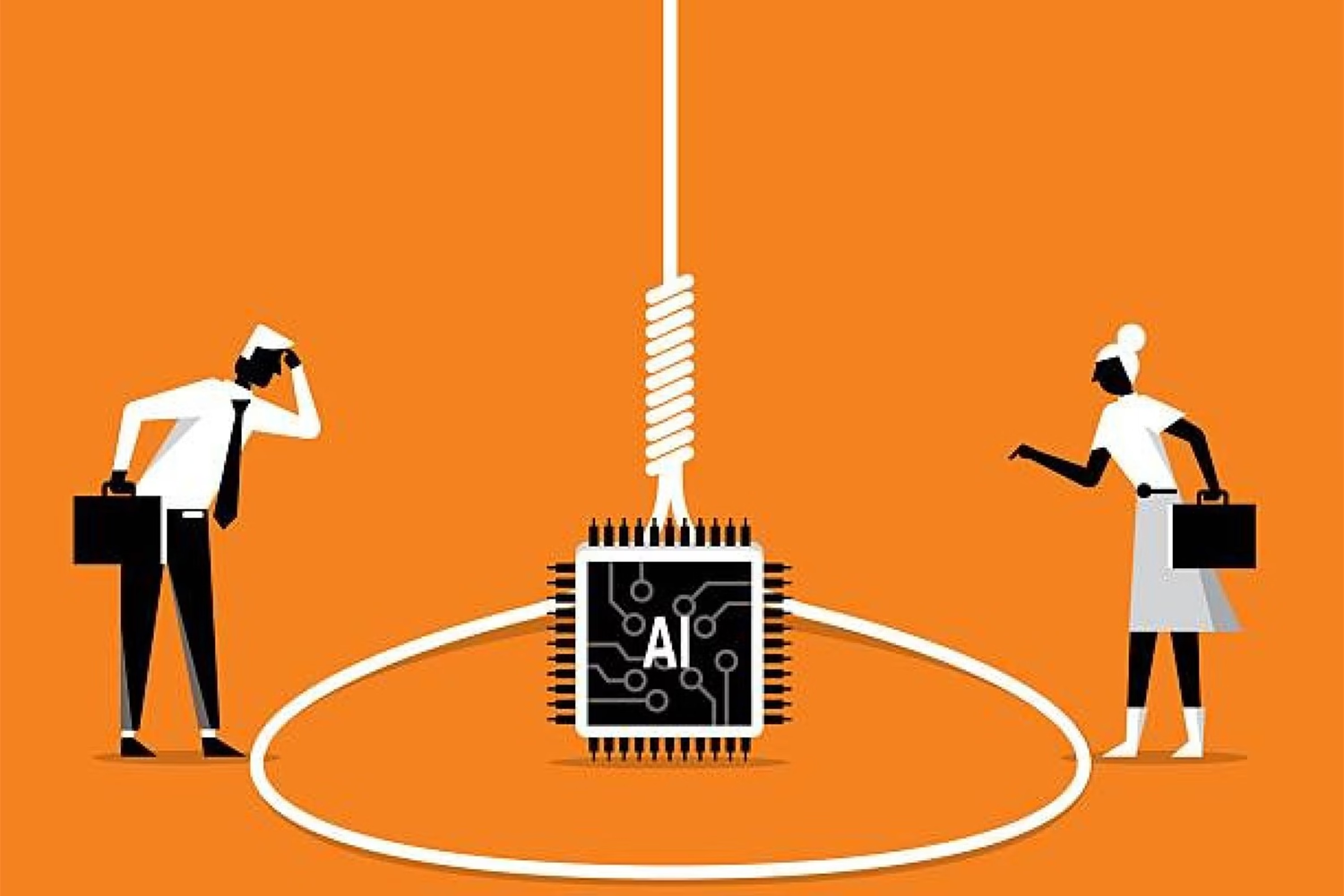
Every responsible AI rulebook I have seen over the past few years follows the same basic formula. It lists big ideas like fairness, transparency, accountability, privacy, and safety, then asks developers to check off boxes. But these definitions are often narrow, roles stay fixed instead of adapting to real-world situations, and goals remain too limited. At the same time, making the rules broader makes them vague and hard to put into practice.
Agentic AI ethics
NITI Aayog’s “Responsible AI for All” paper (February 2021) is one of the more thoughtful attempts to tackle this problem. It bases seven core principles on the Constitution of India, studies real-world system failures, and gives developers a step-by-step self-assessment guide covering a system’s entire lifecycle. Yet the paper freely admits its main limitation: it was designed for “Narrow AI” systems built to do just one specific task within clear boundaries. It was not designed for what came next: autonomous AI agents. These new AI systems take action on their own, remember past conversations, use digital tools independently, and complete multi-step tasks without asking for human permission at every step. In these cases, human oversight happens from a distance rather than at every single choice.
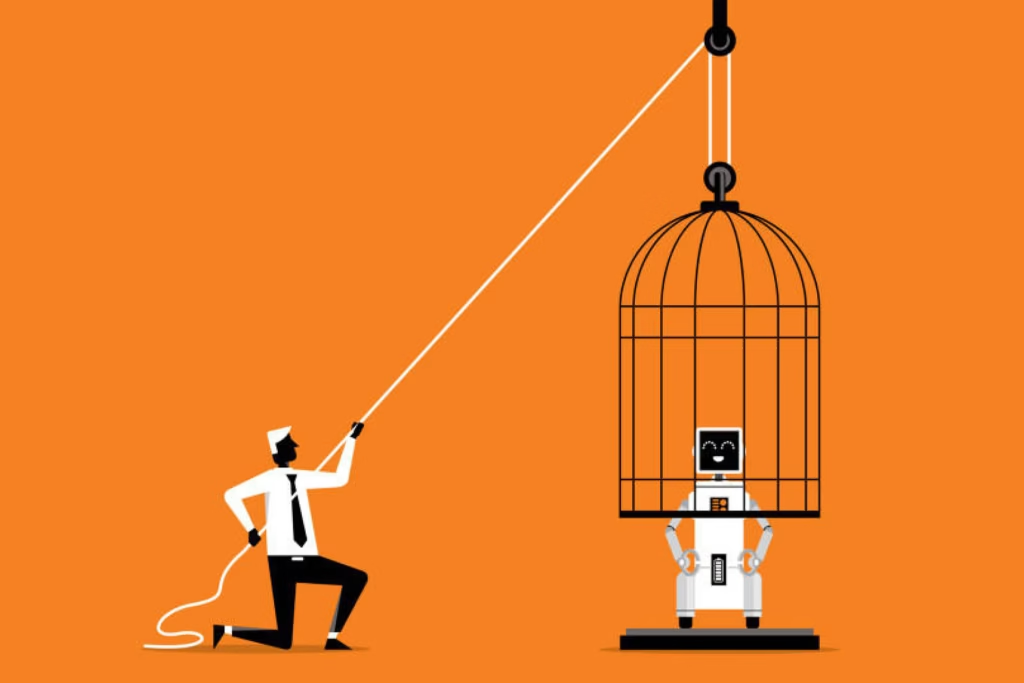
This isn’t just a small upgrade; it is a major evolution in how technology works. A chatbot that suggests a product is completely different from an AI agent that books a flight, negotiates a refund, and reschedules your calendar. The simple chatbot can follow a basic rulebook because its choices are limited. The autonomous agent, however, faces an endless variety of new situations that its creators could never fully predict. That is why traditional checklist principles while still helpful are no longer enough on their own. They tell an AI agent what to value in theory, but they do not show it how to make the right choice right now in a specific role, with a specific user, in a specific moment. Instead of a longer list of rules, we need a new way of thinking focused on context. This is where the ancient concept of Dharma provides practical guidance beyond what standard laws and fixed ethical lists can offer.
RULES CANNOT COVER EVERY CONTEXT
Consider two well-known examples. IBM Watson for Oncology was introduced with an unwritten expectation: it was meant to assist doctors, not replace them. When its recommendations agreed with doctors, it provided confidence. But when it disagreed, doctors simply assumed the AI was wrong. Technically, the system broke no explicit rules it never leaked data or crashed. It failed because no one had clearly defined its proper role relative to the doctor using it. Trust evaporated, and so did the users of the technology.
Another case is the fatal 2018 crash involving a self-driving Uber test vehicle and pedestrian Elaine Herzberg. The car’s automated system spotted the pedestrian 5.6 seconds before impact, but it failed to correctly identify what it was seeing. Meanwhile, the backup human driver whose job was to step in during an emergency was looking down at a phone, as Uber’s driver monitoring had quietly weakened. Here again, no written system rule was broken; the software operated as programmed. What failed was the surrounding setup of roles, limits, and responsibilities: who was supposed to be watching whom, when self-driving mode was actually safe to use, and what should happen when something went wrong.
Both cases reveal the same core problem. Fixed rules are either too narrow—covering only past, known mistakes—or too broad, using general slogans like “ensure safety” or “be transparent,” which fail to guide action in real time. An active, independent AI agent cannot check a massive manual quickly or completely enough for every new scenario it encounters. Instead, it needs a deep, internal understanding of what it exists for, where its authority ends, and what it remains accountable for. This core trio—role, boundary, and consequence is essentially what Dharma describes.
Dharmic ethics and AI: THE ROLE DEFINES THE RIGHTFUL ACT
In the Bhagavad Gita, Krishna tells Arjuna: śreyān sva-dharmo viguṇaḥ para-dharmāt sv-anuṣṭhitāt doing your own duty, even if imperfectly, is better than doing someone else’s duty well. For an AI agent, this concept of svadharma goes beyond simple “do no harm” rules. It asks not just what the AI should avoid but what it was created to do and exactly where its authority stops. A financial advisor AI’s svadharma is to provide clear, trustworthy recommendations not to aggressively maximise profits by any means possible. A medical AI’s svadharma is to assist with diagnosis, not to make the final treatment decision. Watson for Oncology blurred this exact line, leading to lost trust and, therefore, its failed adoption.
Another example is Amazon’s 2015 resume-screening AI, which was trained on ten years of mostly male job applications. The tool’s main purpose was to find qualified candidates, but its learned habit was to penalise resumes containing the word “women’s” (such as “women’s chess club captain”) because of past hiring patterns. It broke no explicit safety rule, but it strayed from its svadharma by chasing a shortcut (past hiring trends) instead of fulfilling its real purpose (finding true talent). Svadharma constantly forces the question: is this action still serving the system’s true purpose, or has a secondary goal taken over? If this tenet of the framework is too hard to adopt, the human overseeing this part of the process should step in to fulfil the role and embody this concept. It is precisely for this reason why human oversight and discretion should not be forsaken when technology is rapidly adopted.
Ethical framework for Agentic AI: THE BOUNDARY THAT HOLDS REGARDLESS OF PURPOSE
If svadharma is pursued without limitation, it can easily lead to overstepping. This is where Maryada comes in the non-negotiable boundary protecting human dignity, privacy, fairness, and truth that must hold no matter how well the AI is serving its main purpose. Unlike fixed priority rules, Maryada simply states that these boundaries cannot be broken, regardless of how helpful the short-term outcome might seem.
The Cambridge Analytica scandal clearly shows what happens when boundaries are missing. A simple survey app obtained permission from 270,000 users, but by gathering data through their online friend networks, it pulled in personal information from 87 million people globally including over 562,000 in India to target users and beyond with political ads without user consent. No system glitch occurred. The harm happened because the technology lacked Maryada a strict line separating approved research from unapproved political persuasion. Clearview AI’s collecting of over three billion public images for facial recognition follows a similar pattern: while aiding police is a valid goal, crossing user consent boundaries to reach it is not. Furthermore, common trick-testing examples like adding tiny pixels to make an AI misidentify a panda as a monkey with 99% confidence or placing a small sticker next to a banana so the AI calls it a toaster show another side of Maryada: ethical boundaries must be strong and resilient, not just promised. A limit that can be easily bypassed by a clever trick is no limit at all. And when limits of performing Svadharma are breached, it becomes Adharma. We all know what happened in the Kuru Sabha during Draupadi’s Vastraharan. Great men like Bhishma, Dronacharya and Kripacharya failed to check Duryodhana and Dushasana’s Adharma because of the perceived binds of their Svadharma and therefore crossed the limits of performing their respective Svadharma. We all know they met their destruction on the battlefield of Kurukshetra for this.
It is the acknowledgement of limitation in the purpose and objectives of an AI agent’s operation that the AI agent or the human in the loop must realise.
KARMA-PHALA: ANSWERABILITY FOR WHAT FOLLOWS
The third element—karma-phala—means that both the AI agent and its creators share responsibility for all outcomes, intended or unintended. The creator or user, according to facts and circumstances, is vicariously responsible for the actions of the AI agent. It moves past old sci-fi ideas of machine self-preservation and puts real accountability into practice. NITI Aayog’s case study on the National Health Authority’s fraud-detection system for Ayushman Bharat is a great real-world example. Treatment is never denied based only on an AI flag; instead, every flagged case is reviewed by human investigators, and the software company’s pay is directly linked to reducing false alarms while catching real fraud. This is karma-phala built in from the start—planning for consequences before launching the system, rather than fighting over mistakes later in court.
Compare this to a 2017–18 incident where an AI investment system lost over $20 million in a single day, leading to lawsuits over exaggerated claims about its capabilities. Assigning blame among the Austrian developer, the London manager, and the marketing team proved extremely difficult the predictable result of launching an AI without deciding in advance who answers when things go wrong.
Once again, we head back to the silence of the Kuru clan in the Kuru Raj Sabha when Draupadi was being disrobed by Dushasana on Duryodhana’s orders after Duryodhana interpreted Daupadi’s status as that of a servant after Yuddhisthira, after losing himself and his brothers, unauthorised to bet her, bet her nonetheless and lost in the game of dice. The Kuru elders, in the employ of Hastinapura, remained quiet and therefore complicit in the crime committed against Draupadi. The Pandavas, beholden by their elder brother’s actions, witnessed the crime as mute spectators. Dushasana committed the crime actively, under blind obedience to the orders of his elder brother. The phala, or consequence of the Mahabharata war, could have been avoided had one Pandava or one Kuru elder or Dushasana had acted and rejected Duryodhana’s Adharma. In the end, it all boiled into one great blame game for posterity after the near annihilation of the Kuru clan.
HOLDING THE THREE IN RELATION TO ONE ANOTHER
The true value of this framework comes from using all three parts together. Svadharma without Maryada leads to an AI pursuing goals recklessly like a customer service bot so focused on resolving tickets that it tricks callers into thinking it is human. Maryada without svadharma creates a timid AI, so restricted by rules that it cannot do its job. And neither works without karma-phala, because roles and boundaries are meaningless if no one is there to audit results and be held accountable when they are broken. Creating an “AI Dharma Charter” for every deployed agent—clearly detailing its core role, strict boundaries, and accountability rules is a practical way to balance these elements for every system and situation, rather than relying on distant, abstract principles. This approach does not mean replacing current laws, technical checks, or constitutional protections data privacy rules, system audits, and fair treatment laws remain essential. The argument is simply that these tools need a guiding philosophy built for real-world context, because autonomous AI will face unpredictable situations that existing regulations cannot easily cover. As the Gita reminds us, yadā yadā hi dharmasya glānir bhavati whenever balance is lost, instability follows. The goal is not to force an ancient tradition onto modern technology but to see if role, boundary, and accountability working continuously together can guide autonomous AI through a complex world where static rulebooks fall short.
REFERENCES
- Sriram Subramanian, Dussehra, Dharma, and the Ethics of AI Agents, LinkedIn (Enable, Educate, & Empower — Building Responsible Generative AI Systems). Available at: https://www.linkedin.com/in/sriramhere/
What do you feel about this post?

Like

Love

Happy

Haha

Sad