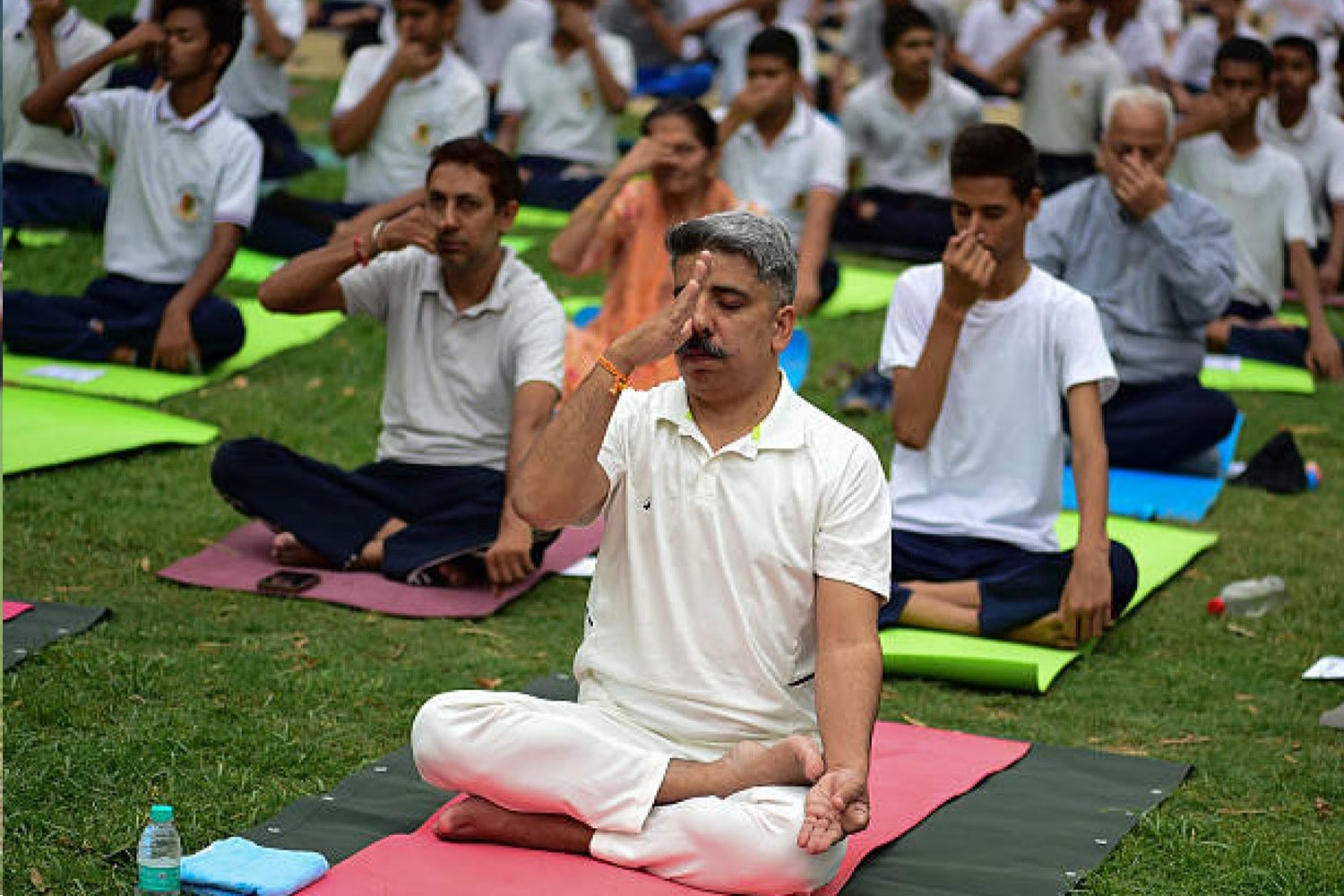
Patanjali Maharishi opens his Yoga Sutras with a line so deceptively simple that most who repeat it never pause to sit with its weight:
“Yogash chitta vritti nirodhah”–
Yoga is the stilling of the fluctuations of the mind.
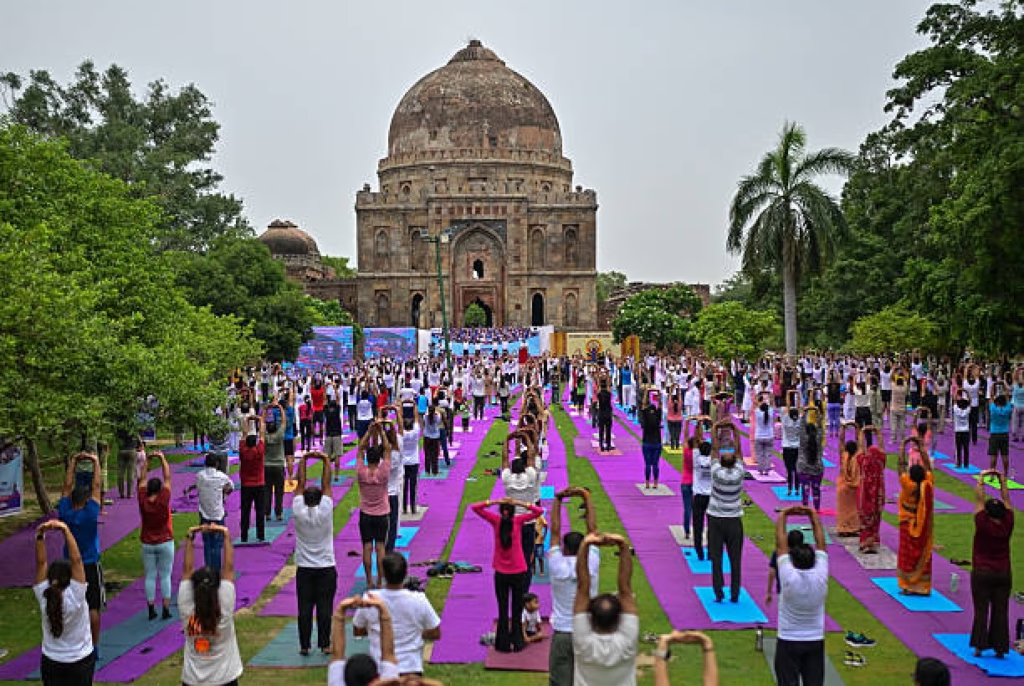
It is not a mere sequence of stretches. It is not a posture held for Instagram reels. It is the stilling of the mind. This single line, composed on Bharat’s soil long before the words “exercise and “fitness” existed in any language, carries within it the entire framework of a discipline that the world has since rebranded into a mat, a pair of leggings, and a playlist of ambient music.
And yet, somehow, despite this ignorant rebranding, Yoga has done something beyond other Indian exports. It has spread outside of the subcontinent and planted itself in the living rooms, classes, gymnasiums, office spaces, grounds and even the United Nations General Assembly of all while carrying, whether the Yoga practitioner realises it or not, the seed of something far deeper and beyond ordinary exercise.
This is the story of how a spiritual philosophy born in the ashrams of ancient Bharat became one of India’s quietest yet most effective instruments of soft power, reshaping how the country exerts itself on the world stage without exertion, even as the world continues to mistake this framework of balance and well-being as just another expression of callisthenics.
ASANA: HOW BHARAT CONQUERED THE WORLD
Here is a fact that might surprise you, whethere a layman or a yoga practitioner. Hatha Yoga, the physical practice of postures that the West has come to see as “Yoga,” is only one branch of the eight branches of Yoga that Acharya Patanjali codified in his Yoga Sutras. Yama, Niyama, Asana, Pranayama, Pratyahara, Dharana, Dhyana, and Samadhi. These loosely translate into – the ethical restraints, the personal observances, the postures, the breath control, the withdrawal of senses, concentration, meditation, and finally holistic absorption. Asana is the third limb, and yet it is the limb the world has chosen to mistake for the whole framework. This is not entirely the fault of the West. It is also a consequence of how in its entirety only this one limb travelled beyond India’s shores.
Much of what the world practices today as Ashtanga, Vinyasa, or Iyengar Yoga traces its lineage to one man – Tirumalai Krishnamacharya, a Brahmin teacher born in a humble South Indian village in the 19th century, who taught at the Sanskrit College in Mysore. From his small teaching room students emerged who would go on to scatter Yoga across continents almost like seeds carried on wind. K. Pattabhi Jois carried forward his teacher’s vigorous, breath-linked sequences and gave the world Ashtanga Vinyasa Yoga. B.K.S. Iyengar, another of Krishnamacharya’s students, built a style centred on precise alignment and the therapeutic power of postures, a style now taught in studios from Buenos Aires to Berlin. Krishnamacharya’s own son, T.K.V. Desikachar, softened the practice further into Vini Yoga, adapting it for the infirm, the pregnant, and the very young. Three students, three continents conquered. This is what soft power of Bharat looks like when it exerts itself without trying.
Also read, May Tech Layoffs Aren’t About the Economy- AI-Agent Swap
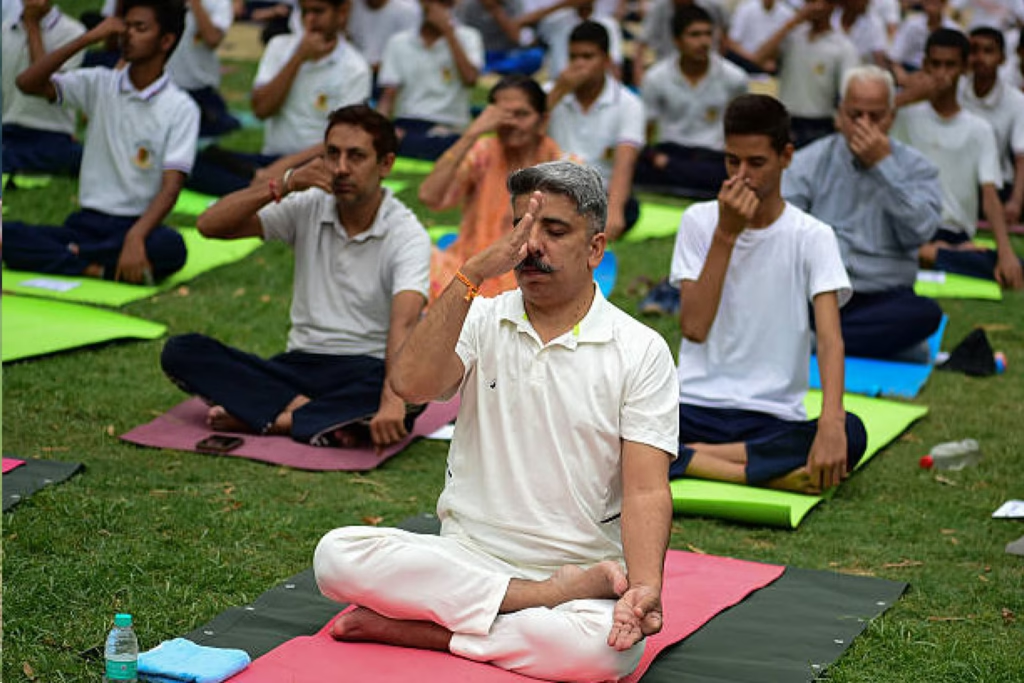
Even the word Asana deserves a pause, because most people who attend a class assume it simply means posture which is a very narrow definition of its scope. Asana more accurately translates to seat, and every asana is traditionally understood as a position from which one settles into stillness, the way one settles into a chair before beginning serious work. Even the lotus pose, the one image almost everyone on earth associates with Yoga even if they have never set foot on a mat, was never designed for flexibility. Padmasana was developed to allow a practitioner to sit for extended periods of meditation without physical distraction, a seat of stillness, not a demonstration of how far one’s hips can rotate or how flexible the legs are. There is a quiet irony here, that the very posture which has become a global shorthand for Yoga was built for stationery calmness, while the world now often uses it, and Yoga at large, to chase sweat, and exercise.
The Asanas themselves carry tales and structures that rarely survives translation when carelessly practiced as part of an exercise routine. For instance, the Bharadvajasana, the twist named after the sage Bharadvaja, asks the practitioner to root one leg in the hero pose while spiralling the spine, a posture said to aid digestion but also, symbolically, to teach the body the discipline of looking backward without losing one’s seat. Baddha Konasana, the bound angle pose familiar to most beginners as the simple seated position with soles of the feet pressed together, is named for the binding of the angle, a gentle opening that prepares the hips for the deeper meditative seats that follow in a traditional practice. Dhanurasana, the bow, curls the body into the shape of an archer’s weapon mid-draw, strengthening the spine while narrating about the legendary discipline of Arjuna himself, poised and controlled rather than reckless. Even Navasana, the boat pose that makes beginners across every gym on the planet groan as they balance on their sit bones, is less about displaying pride in one’s abdominal flexibility and more about teaching the nervous system to find calm in an inherently precarious position. This trivia is not merely for decoration. It is the remainder of a system where every posture was designed to prepare the practitioner for calming and stilling one’s mind.
It is this depth, layered quietly beneath every Suryanamaskar performed in an American gymnasium or a European studio that allowed Yoga to become Bharat’s most successful export to the world. When the United Nations declared the 21st of June as International Day of Yoga, following a proposal that found support from a record number of member nations, it was not a health initiative being endorsed. It was a tacit global acknowledgment that something originating in Bharat had proven valuable enough, across every culture and creed, to deserve a whole day of credit in the world’s calendar. Now Suryanamaskar is practiced on well-manicured lawns that once knew India only as a British colony or a misinterpreted backwater state. Yoga studios have become small, unofficial embassies of Indian thought, scattered across from Tokyo, in the east to Los Angeles in the west, run by people who have never visited Bharat but who, without quite realising it, are sharing a worldview steeped in dharma, discipline, and the idea that the mind can be trained the way a muscle can.
But here is the catch, much like Adharma is not simply the inverse of Dharma but its excess or deficiency, the danger facing Yoga today is not that it has spread too far, but that it has spread too thin. A studio that teaches only the Asana, only the third limb, without any passing references to the other seven limbs that surround it, risks reducing a complete system of mental and physical welfare into a workout class that has been marketed better. Bharat has to stem the liquidation of Yoga’s message by exerting its soft power to spread awareness of this system beyond its restricted confines of physical workouts Every teacher trained, every certification issued, every tutorial filmed carries within it a choice on whether to present Yoga as a flowing sequence of postures for a flatter stomach or tighter glutes, or to indicate, toward the greater philosophy of physical preparation and mental stillness that birthed those postures in the first place. The world has already accepted the body of Yoga. The civilisational task ahead is ensuring it does not forget the breath that reinforces it.
CONCLUSION
From the forest hermitages of ancient Bharat to the corporate wellness rooms of Silicon Valley, Yoga’s journey has been one of the most seemingly impossible victories of the modern age, achieved not through policy or persuasion but through the quiet, repetition. Patanjali’s Yoga Sutra reminds us where this all began and eventually return I.e. to the calming and stilling of the mind and not losing weight through poses. As Bharat continues to watch its ancient export circle the globe, Bharat has chosen to responsibly spread its message instead of jealously guarding its knowledge. The Asana is not the final achievement, but a process towards mental balance and stability. Bharat would do well to keep telling its story, before the world finishes rewriting its message and writing it off as yet another health fad.
What do you feel about this post?

Like

Love

Happy

Haha

Sad


Informative article
Beautiful explanation about yoga. Very nicely written.
Wonderful article and keep it up
Informative and useful article.
Very informative
Very well researched and written article. Way to go!!
Very nice
Thanks for the article. Came to know different types of Yogas. Request to be more detail on the various types of Yogas.
Excellent
Article with valuable inputs. Keep writing and eager to hear more from you Mr Vignesh