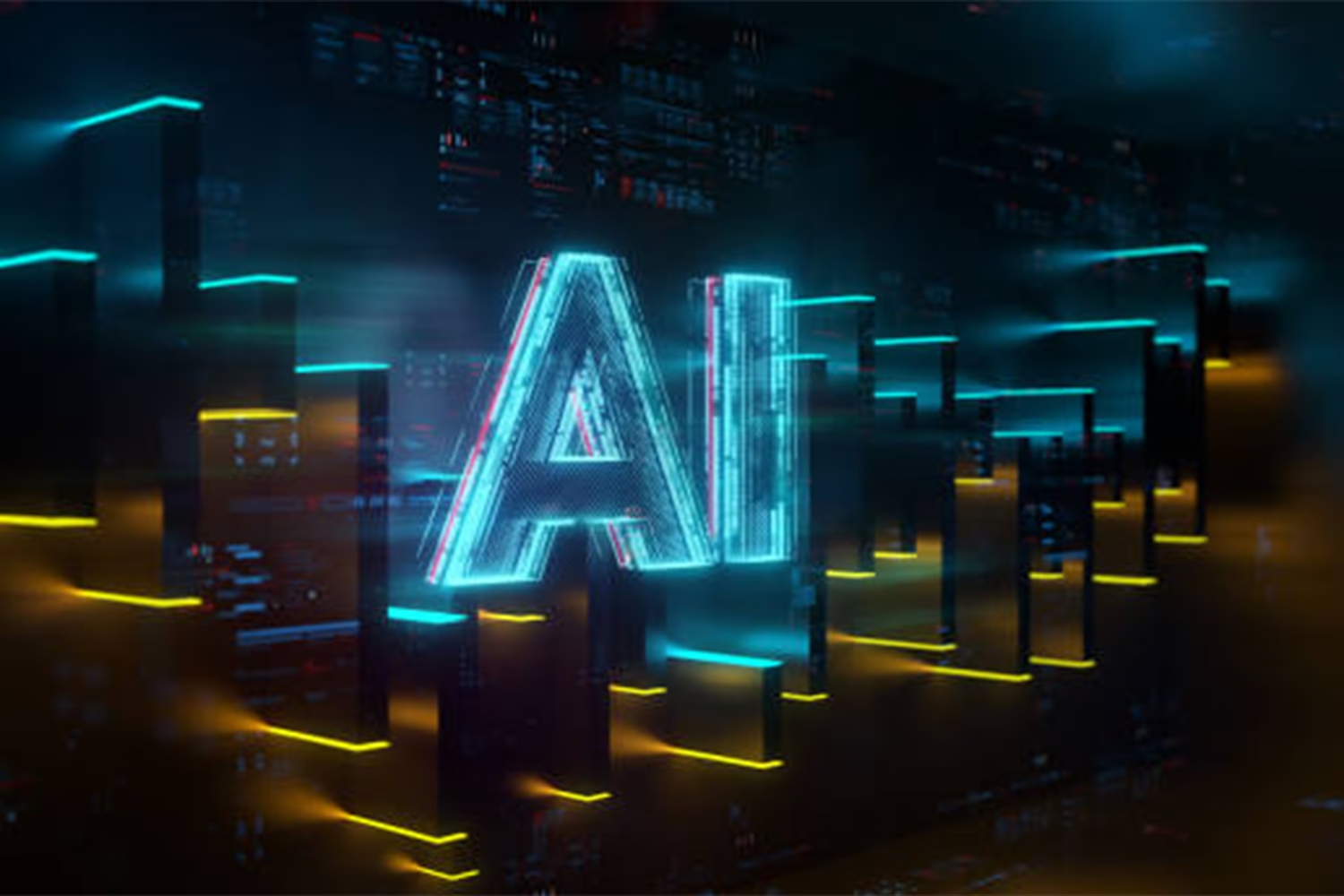
Age of AI through Dharma – Introduction
We live in a world of make-believe and refinement. Everything is about enhancing our image in the real world through what we project in our virtual lives. This is all rooted in our rapidly changing intentions. With these digital adornments becoming the new staple, the world has long since entered a post-information age where online content is curated merely to maintain empty images in social circles instead of sharing about our lives. But while social media is increasingly used as a platform to float these virtual optimizations, the use of AI has added to this conundrum. In fact, the technological strides in AI appear to be almost miraculous; until 2019, technological developments appeared trivial.
Now, we can synthetically generate information without an ounce of truth in it, and it is addictive and thrilling due to the easy access and ease of using this technology. Content generated using Generative AI tools has flooded our lives with lies, creating entire mirages far removed from reality. Suddenly, we can create whole new personas for ourselves without any effort, thereby making the consumption of this content extremely convenient without any genuine appreciation.
Now, this is not to criticize AI, for AI, when used to share awareness, serves as a beacon of knowledge, keeping people clued-in and well-informed. Armed with AI, well-intentioned people create engines of growth and development for society. But the dark side of its access and use is largely driven by human motives to spread misinformation. After all, whatever information AI serves us as output is generated using human knowledge as its foundation.
When it simply comes to doom scrolling through this content, it does not cause much harm or injury. However, it can cause us to fall into a deadly cycle of passive acceptance where we succumb to algorithms doing all the work for us, sacrificing the application of our mind and other cognitive abilities to achieve what we seek.
But when people perceive it as real, causing them to suffer through economic and social fallout, the consequences are very real despite its fake origins. This Age of Lies and Fabrication is not new, and India, i.e., Bharat, has ancient lessons steeped in values that urge us to keep our eyes alert and minds open.

ITIHASA: A Simple Guide to Navigating Manufactured Reality
We have all heard or read about the Ramayana and Mahabharata and how our dharmic epics are all about the victory of Dharma over Adharma. But here is the catch. Adharma is not the inverse of Dharma. It is either an excess or deficiency of Dharma. Dharma does not mean being moral or ethical. It is roughly the cosmic order of righteousness that governs individuals and societies. But what does this have to do with AI and the output it generates?
Well, today in this “era of manufactured reality” and shifting dunes of information, the shore is found in the values of Dharma that are endorsed by our Indian epics. For instance, while it is good to have faith and trust in people, Dharma does not advocate blind trust or vesting absolute faith in anyone, even if it is family. After all, it was Maharani Kaikeyi—whom Maryada Purushottam Shri Ram held to be his mother despite not being born from her womb—who had him sent on a fourteen-year exile to the forest. Similarly, in the Mahabharata, the cousins of the Pandavas, the Kauravas, subjected the Pandavas and their wife, Devi Draupadi, to twelve years of exile in the forest and one year of exile in disguise after cheating in a game of dice. This is not to discourage the reader but to simply suggest erring on the side of caution and being vigilant rather than mindlessly believing everything, be it information on the internet or people.
At the same time, our Dharma does not advocate simply lying down and passively accepting things as they come. Once again, taking the example of Shri Rama, who willingly sacrificed the throne of Ayodhya just to keep his father’s word, he allied with the Vanaras and Maharaja Sugreeva, doing everything that was needed to declare war on Lanka and rescue his wife, Devi Sita, from the clutches of Ravana. This included actively taking matters into his own hands and getting them dirty by killing Vanaraj Vali in what appeared to be an underhanded move but was needed to establish Dharma. He applied his mind, weighed the consequences, made the judgment, and took the shot.
Then there were the tactics practiced by the Pandavas themselves under the guidance of Shri Krishna, uprooting the obstacles that stood in their way; despite the tactics appearing underhanded, they were necessary for the establishment of Dharma. They did not blindly follow Shri Krishna and surrender their human agency merely because he said so. It took the illumination of the Bhagavad Gita from the lips of Shri Krishna himself to enlighten Arjuna’s mind and dissolve his passivity to urge him to act against the adharmic elements among the Kauravas.
While these incidents highlight extraordinary factors, they also underline the root of lies used to wage psychological warfare that nearly broke the wills of warriors of Dharma, even though their minds were focused and committed. This is much like the misinformation generated by AI today, which is used to brainwash people into believing whitewashed lies that sway opinions in favor of misguided or deceitful causes. For instance, even Prabhu Ram, the most focused and calm warrior of his age, grew agitated when Indrajit, a master of illusion and deceit, cut off the head of Maya Sita to break his will and render his rightful cause headless by making it seem that his very reason to fight had been eliminated. It took Vibhishana’s intelligence and accurate information to dispel the source of Shri Rama’s agitation, revealing Indrajit’s weakness and explaining Ravana’s mindset regarding why he would never sacrifice Mata Sita. Vibhishana clearly advised Shri Rama on the next course of action, which was directing Shri Lakshmana to wage war at night to eliminate Indrajit before he became invincible.
There are numerous instances in the Mahabharata too where the cunning deceit of Shakuni was combated by the accurate intelligence and wisdom of Vidura and Shri Krishna, thereby eventually leading to Dharma emerging victorious despite the steep cost that had to be borne by the Pandavas and their lineage.

CONCLUSION
In the end, our Itihasa reminds us that vigilance is not an optional exercise but the need of the hour. Just as Shri Rama and the Pandavas never surrendered their agency blindly, we too must resist the temptation of passive acceptance in this age of institutionalized deceit. AI may flood our lives with information, but it is our responsibility to weigh, question, and act with discernment and clarity. Dharma is not a rigid template of morality and ethics; it is an overarching framework of balance, judgment, and the courage to act when required. If we keep our eyes open and our minds alert, no amount of deception, whether spun by man or machine, can truly uproot us. This is the call of Dharma today: be cautious, be conscious, and never abandon the application of your own mind.
What do you feel about this post?

Like

Love

Happy

Haha

Sad

Well written. A good analysis of the subject. Keep it up😊👍👏👏🎉🎉
A good comparison with Ramayana and Mahabharat to drive home the dangers of AI.
Loved it.
Wonderfully analysed and written Vignesh!!! A lot of people, especially the older generation, can’t make out that the videos are fake and blindly believe everything and that’s such a shame
Excellent. Quotiing apt instances from our great puranas and itihasas to caution about the negative side of AI is truly remarkable.
Excellent Vignesh. Very timely article. Keep up the good work. 👏🏻👏🏻
Nice and timely article. Indeed there is a lot of clutter created by AI and become a conundrum that most are unable to make it whether it is good or bad. The surprise element is bringing Dharma into the discussion and connecting it to AI !!
It is the need of the hour message very nicely clarified. Getting anything and everything without any effort and believing in it or not believing it without using one’s own study can result in catastrophic damage for ever
Though AI is there, Natural Intelligence or Self Intelligence should preside before any Fast Food
Great work well Portrayed by Master Vignesh
Excellent write up and well researched article. Way to go Vignesh.