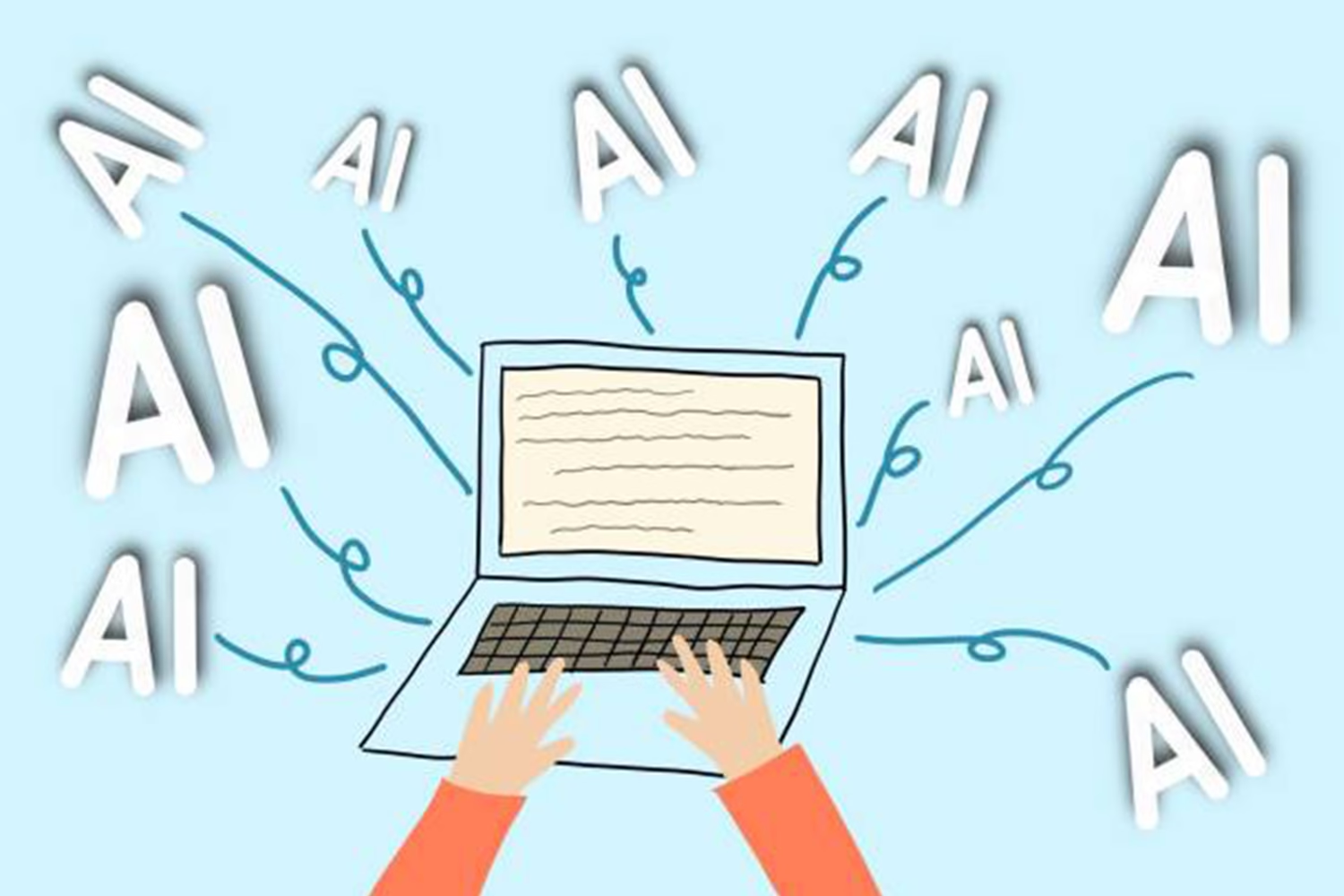

NEW YORK – As Wall Street firms look ahead to another lucrative quarter while Austin continues its tech boom and Utah experiences the growth of its “Silicon Slopes” business district, the American workplace is experiencing yet another period of radical change. But this time, it is not being powered by a shiny, novel piece of hardware—it is the silent, ever-present power of Artificial Intelligence.

With 2026 halfway through, AI tools have moved from novelty to necessity. The once-standard “nine-to-five” office job is quickly being upstaged by “agentic” AI solutions, which perform highly complex tasks without requiring extensive user intervention.
A New American Toolkit: Beyond the Chatbot
The revolution is particularly pronounced in America’s legal and finance industries. In firms based in New York, tools such as Harvey and AlphaSense have become increasingly common. Over the past two years, these tools have gone through a series of upgrades. They not only summarize deposition but perform multifunctional forensic auditing and formulate complex litigation strategies that previously required weeks of work by junior lawyers.
Los Angeles and Chicago, which are known for their artistic prowess and marketing expertise, respectively, have found ways to overcome “blank page syndrome.” Artists employ software such as Nano Banana Pro and Midjourney v8 to produce detailed prototypes by giving voice commands. Meanwhile, marketers use Lyria 3 to create custom musical scores for their national advertising campaigns within thirty seconds.
Productivity vs. Presence: The Great Re-evaluation
Type your paragraph here
The implementation of artificial intelligence (AI) has sparked renewed interest in the four-day workweek phenomenon in the United States. As AI takes care of “drudgery work”—scheduling, data input, and draft creation—the productivity of American workers has been observed to rise by 40%, thanks to more time dedicated to “deep work.”
“I haven’t lost my job to AI,” says Marcus Thorne, a Senior Project Manager at a tech company in Seattle, Washington. “AI took my worst job responsibilities away. Instead of dealing with spreadsheets and battling calendar invites, I’m spending my day problem-solving and interacting with clients.”
But now comes a brand-new issue for America’s workforce: The Upskilling Crisis. The most essential skill set of 2026 won’t be coding or arithmetic but AI Orchestration. It is defined as the skill to operate several AI applications at once to produce a unified outcome. There’s a clear split happening in the American workforce between AI leaders and followers.
AI systems are now able to conduct imaging analysis with an accuracy rate higher than the human radiologist counterparts by 15%, according to medical capitals like Boston. As far as the software industry is concerned, GitHub Copilot X has turned coding into curating, whereby software engineers are spending more time assessing the code logic than writing the code itself.

The Ethical Frontier and the “American Guardrail”
With the increasing independence of AI systems, the Orbis Chronicle has noticed a growing trend of “Algorithmic Anxiety” throughout the nation. The debates over bias in employment algorithms and data privacy continue to dominate the legislative scene in Washington D.C.
The recently enacted 2026 U.S. AI Transparency Act, signed just earlier this year, requires transparency in all content produced by AI technology in public sectors or consumer-oriented financial advising services. However, to the average American employee, the question is personal – if AI can perform 80% of my duties, what am I worth?
The solution, according to experts, is in the Human-in-the-Loop (HITL) model. AI delivers the magnitude and efficiency, while the American worker supplies the ethical standards, cultural norms, and “sixth sense” that silicon cannot mimic.
“The Future of the ‘Job'”
The United States is approaching the age of “Gig Economy 2.0,” with the advent of AI technologies reducing the entry requirements for highly skilled occupations, resulting in the emergence of “solopreneurs”—people who manage multimillion-dollar ventures from their home offices, using solely an AI system as their team.
According to Orbis Chronicle, by 2030, the very idea of a “job description” will be rendered obsolete, replaced by the notion of a “skill portfolio.” In this future scenario, your biggest advantage will no longer be your education or experience; rather, it will be your flexibility and capacity to evolve alongside technology.Your silicon partner is here to stay, whether on the East Coast or West Coast. The last question for the American worker remains: are you ready to work side by side with your silicon partner?
What do you feel about this post?

Like

Love

Happy

Haha

Sad